
Framer Notification System: Ask Questions That Convert
 Solt Wagner
Why Your Framer Notifications Aren’t Getting Answers
If your in-app prompts feel like they’re shouting into the void, you’re not alone. A lot of teams “add a notification” and assume responses will follow. But a Framer notification system ask questions setup only works when the question is genuinely easy to answer in that moment. Otherwise, users do what users do: they ignore it, dismiss it, or mentally file it under “later” (which quietly means “never”).
The hidden friction in “quick questions”
Most “quick questions” aren’t quick. They often require context the user doesn’t have, or they demand a judgment call (“How are we doing?”) that takes emotional energy. In my experience, the smallest friction point—like needing to type—can collapse response rates, even if your Framer notification system ask questions flow looks clean.
When timing kills response rates
Timing is the invisible deal-breaker. Ask while someone is mid-task (editing, scrolling, comparing, purchasing) and your prompt becomes an obstacle. A better approach is to trigger questions after a natural “done” moment, so your Framer notifications feel like a helpful check-in rather than an interruption.
How unclear intent makes users ignore you
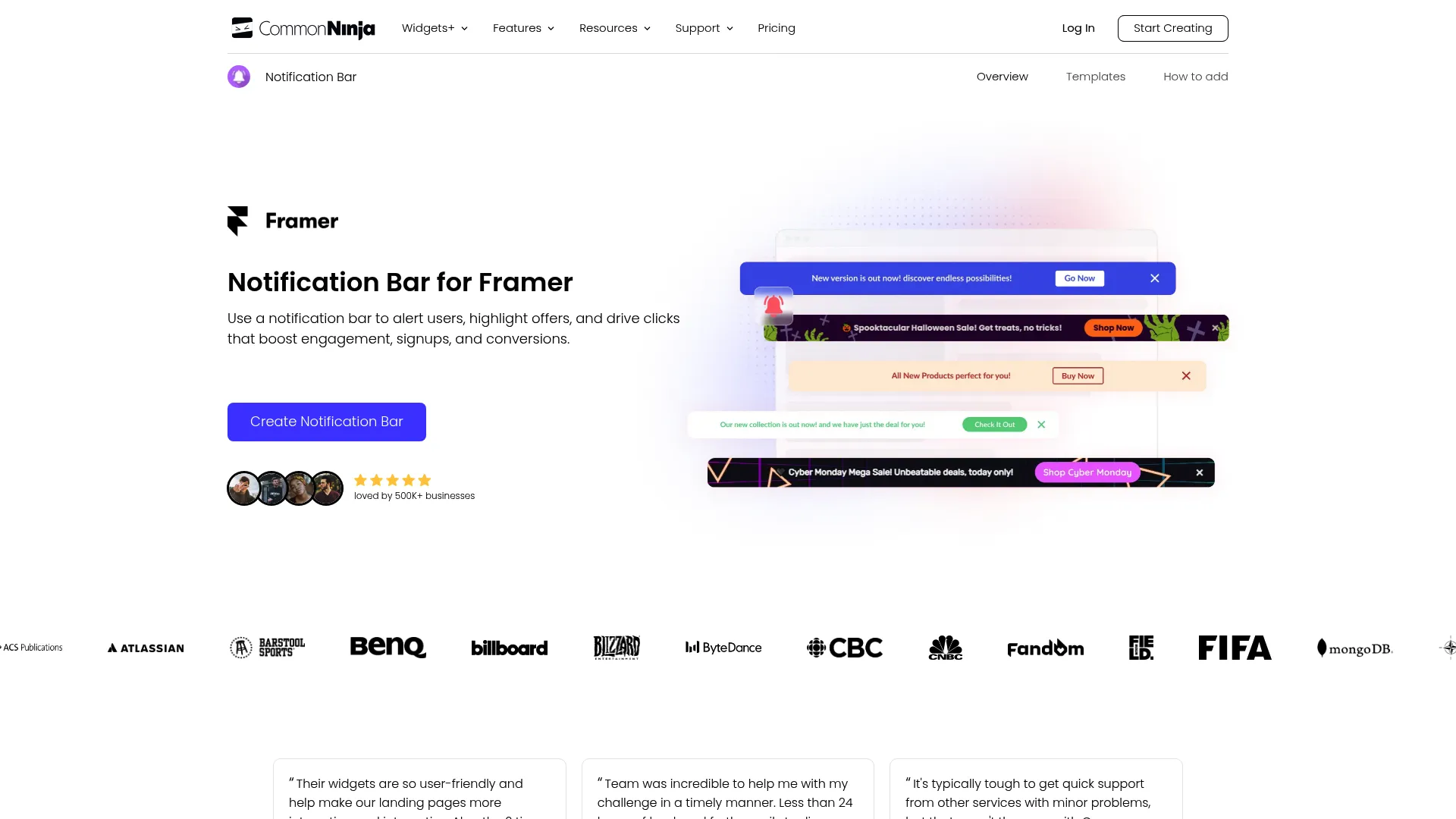
If the user can’t tell why you’re asking, they’ll assume it’s for your benefit, not theirs. That’s where many teams slip on notification copywriting: they ask something broad, then provide no reason, no payoff, and no clear next step. If you need UI patterns for how notifications can look and animate, skim Notification UI Components & Animations and notice how the best ones make the action obvious and lightweight.
For Frameblox specifically, you’re often asking builders and designers who are moving fast. When someone is grabbing a section from your library or exploring Components, your questions must respect momentum. The rest of this post is about building a Framer notification system ask questions workflow that gets answers without slowing users down.
The 3 Question Types That Work Best in Notifications
The best Framer notification system ask questions setups don’t rely on “one perfect question.” They rely on a few reliable formats you can reuse across pages, moments, and segments. If you choose the right question type, you lower effort, increase clarity, and make it easy for users to answer honestly—even if they’re busy.
Binary questions that remove effort
Yes/No questions work because they’re fast and emotionally safe. A user doesn’t have to explain themselves; they just tap. For product messaging best practices, I like binary prompts when you’re validating direction, like “Did you find what you needed?” right after a successful action.
Multiple choice that reveals intent
Multiple choice is the sweet spot for user feedback prompts because it captures nuance without demanding typing. The key is to write options that map to real user intent (price, fit, missing component, confusion) and include an “Other” escape hatch. If you’re experimenting with lightweight UI add-ons, you can also look at Notification Bar plugin for Framer - to see how simple bars can host quick choices.
One-line openers that invite detail
Open text can work in a Framer notification system ask questions flow if you keep it tiny: one sentence, one field, one clear promise. Instead of “Tell us your thoughts,” try “What’s one component you wish Frameblox had?” That phrasing gives users a starting point, and you’ll get more usable answers for your roadmap.
When Frameblox users browse All components, multiple-choice prompts can quickly tell you whether they’re searching by style, layout type, or a specific use case. And once you have that, your Framer notifications can become genuinely helpful instead of generic.
Designing the Notification UI in Framer (Without Overthinking It)
A clean UI matters, but you don’t need to obsess over every pixel to ship a solid Framer notification system ask questions flow. The goal is simple: make the prompt easy to notice, easy to understand, and easy to dismiss. When the UI gets too clever, users hesitate—and hesitation is where responses go to die.
Toast vs banner vs modal: choosing the right container
Toasts are great for low-stakes questions right after an action, because they feel lightweight and don’t block the page. Banners work when you need persistence (like a question tied to a page), but they must be easy to close. Modals are powerful but risky; I reserve them for moments where asking is essential, not “nice to have.”
Making it accessible: contrast, focus, motion
Accessibility is part of good in-app notification UX, not a bonus. Use readable contrast, ensure keyboard focus lands inside the notification, and avoid motion that feels jumpy or unskippable. A subtle slide-in with a clear close button typically performs better than dramatic animations that steal attention.
Building reusable components for speed
The fastest teams build a “notification base” component with variants: success, info, question, and warning. In Frameblox terms, think of it like having a consistent section template—you swap the content, not the structure. If you’re curious how other builders think about notifications in Framer, check How to add push-notifications in Framer? for community discussions and approaches.
If you’re already using Frameblox as your design system foundation (start here: frameblox.com), treat notifications the same way you treat buttons and forms: a reusable set of primitives. That mindset makes your Framer notification system ask questions process scalable across pages, including more specialized areas like Styles or a more technical section like Code.
Microcopy That Gets Replies: Word Choices That Change Everything

Microcopy is where your Framer notification system ask questions strategy either clicks—or quietly fails. The UI might be perfect, but if the words feel needy, unclear, or robotic, users won’t engage. Good copy sounds like a competent teammate: specific, respectful, and quick to the point.
The difference between asking and begging
Begging copy adds pressure: “Please help us improve!” or “We’d love your feedback!” It’s well-intentioned, but it puts emotional labor on the user without explaining the value. Asking copy is crisp and neutral: “Was this component easy to customize?” with a one-tap answer.
Short prompts that feel personal, not robotic
The best notification copywriting uses simple words and avoids corporate filler. “Quick check—did the navbar work on mobile?” sounds human, because it’s specific and tied to what the user just did. I’ve found that using “quick check” or “one question” works well, as long as you actually keep it to one question.
Buttons and labels that nudge action
Button labels should complete the sentence, not repeat “Submit.” For binary prompts, “Yes” and “Not yet” often outperform “Yes” and “No,” because “Not yet” feels less confrontational. If your Framer notifications include multiple choice, keep options short (2–5 words) and make them mutually exclusive.
For Frameblox, this is especially important because your audience cares about craft. If the microcopy is sloppy, it undermines trust in the system behind it. Tight wording turns a Framer notification system ask questions prompt into a quick, confident interaction that matches the quality of a UI kit and design system.
Trigger Rules: When to Ask the Question (So It Doesn’t Feel Annoying)

The fastest way to make users hate your Framer notification system ask questions flow is to show it too often, or at the wrong time. Triggering is really about empathy: “Is this a moment when the user has spare attention?” If the answer is no, your prompt becomes noise—no matter how great the copy is.
Event-based triggers that feel natural
Event-based triggers are tied to something the user just did: copied a section, viewed three components, or bookmarked a page. This is where Framer notifications shine, because the user already has context and the question can be specific. For example: “Did this hero section match your layout needs?” right after a preview.
Frequency caps and cooldowns
Frequency caps prevent fatigue. A practical baseline is one question per session, with a cooldown of 7–14 days for the same prompt, depending on traffic and usage. In my experience, users don’t mind being asked occasionally—they mind being asked repeatedly with no memory of past answers.
Respecting context: first-time vs power users
First-time users need guidance, not interrogation. Ask onboarding-style questions only after a success moment, like finding a component or completing a customization. Power users, on the other hand, can handle deeper prompts—especially if you reference what they’ve done and keep the effort low.
For Frameblox, you might trigger based on browsing depth inside Components: a newcomer gets “Did you find what you needed?” while a repeat visitor gets “What’s missing from the library right now?” That’s the heart of in-app notification UX: same system, different respect for context.
Smart Personalization in Framer: Make the Ask Feel Tailored
Personalization doesn’t have to mean creepy tracking. In a good Framer notification system ask questions build, personalization is mostly about using obvious context: what page they’re on, what they just clicked, and whether they’ve seen the prompt before. When the question feels tailored, users answer because it feels relevant, not because you “captured feedback.”
Using user state to change the question
User state can be simple: new vs returning, or “saved a component” vs “just browsing.” If someone just explored a set of sections, ask about findability; if they interacted with styles, ask about customization. This is a practical way to apply product messaging best practices without building a complicated data pipeline.
Segmenting by page, action, or plan tier
Segment by what the user is trying to accomplish. On a pricing or promo page, questions can clarify objections (“Was pricing clear?”), while on a library page, questions can identify missing assets (“Which category is missing?”). If you have plan tiers, keep it respectful—ask about value and fit, not personal details.
Progressive questions over time
Progressive questioning means you don’t ask everything at once. You start with a low-effort binary question, then—only if they engage—follow up later with a multiple choice or a one-line text prompt. This approach keeps your Framer notification system ask questions strategy lightweight while still collecting richer insights over weeks.
If you run promotions like Framer Black Friday, personalization can also help you ask smarter post-purchase questions. For example: “Was it clear what you get instantly vs later updates?” That’s not just feedback—it’s reducing support load.
Answer Collection: Where Responses Should Go (and How to Track Them)
Asking better questions is only half of a Framer notification system ask questions setup. The other half is making sure answers don’t disappear into a spreadsheet graveyard. You want a simple collection path that your team will actually look at weekly, with enough structure to turn responses into product decisions.
Logging responses with minimal setup
You don’t need a complex backend to start. Many teams log responses to a tool they already use: a form endpoint, a lightweight database, or even a dedicated Slack channel for qualitative feedback. The key is to capture the answer plus a tiny bit of context—page, timestamp, and prompt ID—so it’s not meaningless later.
What to measure: response rate, completion, sentiment
Response rate tells you if the question is reasonable; completion tells you if the UI flow is smooth (especially for multi-step prompts). Sentiment can be as simple as tagging responses positive/neutral/negative during review, rather than trying to automate everything. For in-app notification UX, these three metrics are usually enough to spot problems quickly.
Tagging answers to features or pages
Tagging is where feedback becomes useful. If a user says “Couldn’t find pricing details,” that should be tagged to the pricing page and whatever UI element failed them. Over time, a well-tagged Framer notification system ask questions program shows you patterns—like which component categories confuse users or which pages create drop-offs.
For Frameblox, I’d strongly consider tagging by library area: sections, components, styles, and code. It helps you see whether the design system itself is discoverable, and it gives you clean input on what to build next inside All.
Privacy, Permission, and Trust: Ask Without Getting Creepy
A Framer notification system ask questions flow is fundamentally a trust exercise. Users are giving you attention and information; you’re promising you won’t misuse it. The good news is you can build trust with simple habits: ask less, explain why, and avoid collecting anything you don’t truly need.
What counts as personal data in feedback
Personal data can include obvious things like name and email, but also less obvious items like free-form text that contains identifying details. If you ask open-ended questions, assume some users will include personal info even if you didn’t request it. That’s why it’s smart to keep user feedback prompts focused and discourage sharing sensitive details.
Consent-friendly wording
Good consent wording is calm and specific. A line like “Your answer helps us improve the component library—no personal details needed” sets expectations without sounding legalistic. If you’re using Framer notifications to prompt feedback, also make “Dismiss” easy; forcing interaction creates resentment, not insight.
Retention and deletion basics
Decide how long you’ll keep responses and who can access them. Even a simple policy like “We retain feedback for 12 months and delete on request” is better than “forever by accident.” If you tie answers to user accounts, give users a straightforward path to request deletion and keep internal access limited.
For a design-system product like Frameblox, privacy-friendly feedback often performs better anyway. Your audience tends to be detail-oriented; they notice when you’re respectful. A trustworthy Framer notification system ask questions setup becomes part of your brand quality—not just a growth tactic.
Testing the System: A/B Your Questions, Not Just Colors
If you want real gains, test the parts that actually change behavior: the question, the timing, and the format. Too many teams tweak the background color and call it optimization. A solid Framer notification system ask questions practice treats every prompt like a hypothesis you can validate with small, careful experiments.
What to test first: prompt, timing, or format
Start with the prompt because it’s the biggest lever. If the wording is unclear, nothing else matters. Then test timing (after which event the question appears), and only then test format (toast vs banner, button placement, etc.), because format tends to be a smaller improvement compared to relevance and clarity.
Avoiding biased questions and leading options
Leading questions inflate “positive” responses and give you false confidence. “How much did you love this?” is basically asking for a compliment, not information. Neutral notification copywriting sounds more like research: “How would you rate the customization experience?” with balanced options and a clear “Not sure” choice when appropriate.
How to decide a winner with small samples
With small samples, focus on directional learning rather than statistical perfection. If Prompt A gets 2× the response rate of Prompt B over a similar period and traffic mix, that’s often enough to choose A and keep iterating. Track changes carefully so your Framer notification system ask questions experiments don’t overlap and muddy the results.
If Frameblox traffic spikes during launches or promos, note that in your testing log. A question that works during a high-intent week may underperform during calmer weeks, so keep context alongside results. That’s part of responsible product messaging best practices: interpret feedback honestly.
Notification Templates You Can Copy Today (With Best-Use Scenarios)
Templates save time, but only if they’re matched to the right moment. Below are patterns I’ve used (and seen work) that fit naturally into a Framer notification system ask questions workflow. Treat these as starting points—swap in your own events, pages, and component categories so the prompt feels native to Frameblox.
Activation questions after first success
Ask right after the user completes a meaningful action, like finding a section they like or exploring a component set. Template: “Quick check—did you find a section you’d actually ship?” Buttons: “Yes” / “Not yet.” This improves Framer notifications because it’s tied to a concrete moment, not a vague feeling.
- Best use: first session, right after a preview, copy, or save event
- Follow-up (later): “What type of section were you looking for?” (multiple choice)
Churn-risk questions after inactivity
If a user hasn’t returned in a while, keep the question low-pressure and helpful. Template: “Want help finding the right components faster?” Buttons: “Yes—show me” / “No thanks.” If they click yes, offer a short multiple choice: “What are you building?” with 3–5 options that map to Frameblox categories.
- Best use: returning visit after 14–30 days of inactivity
- Goal: reveal blockers without shaming the user for leaving
Feature discovery questions after exploration
After someone browses multiple categories, ask a question that guides discovery and teaches value at the same time. Template: “Are you trying to move fast or match an existing brand?” Options: “Move fast” / “Match my brand” / “Both.” This kind of Framer notification system ask questions prompt doubles as segmentation for future messaging.
- Best use: after 3–5 page views across the library
- Bonus: route “Match my brand” users to Styles
If you want a simple way to operationalize templates, create a “Prompt Library” page internally: prompt text, type (binary/multiple choice/open), trigger rule, and a link to the component in Framer. That keeps your Framer notification system ask questions process consistent as Frameblox grows past 400+ components and beyond.
A Simple Build Checklist to Ship Your Framer Q&A Notifications
This section is the practical “ship it” part. A Framer notification system ask questions build doesn’t need to be complex, but it does need to be consistent. If you cover the basics—UI states, clear questions, sensible triggers, and tracking—you’ll have a system you can iterate on without redoing everything each time.
Component checklist: states, animations, dismiss
Create variants for default, hover, focus, success/thanks, and error (if you collect text). Keep animation subtle and predictable: a 150–250ms slide/fade is usually enough. Always include a clear dismiss action, because forced prompts damage in-app notification UX and make the whole system feel spammy.
- Default + success state (“Thanks—got it”) so users feel closure
- Keyboard focus order that lands on the question and buttons
- Dismiss that persists (don’t re-show immediately after refresh)
Question checklist: clarity, effort, relevance
Before shipping any prompt, read it out loud and ask: would a busy designer answer this in three seconds? If not, simplify. The best user feedback prompts are specific, low-effort, and tied to what just happened, not what you wish happened.
- One question per notification (no stacked asks)
- Answer options that cover the most likely intents
- No guilt language (“Help us…”, “Please…”), just a clear ask
Launch checklist: caps, tracking, rollback
Set frequency caps from day one, and don’t launch without a way to see results. A simple dashboard or weekly review doc works as long as it’s consistent. Also plan a rollback: if a prompt annoys users or breaks a flow, you should be able to disable it quickly without touching every page.
- Frequency cap: 1 prompt/session; cooldown 7–14 days per prompt
- Track: prompt ID, page, timestamp, response, dismiss
- Rollback switch: a single variable/flag to turn off the prompt
If you’re building this inside a design system mindset, it can live alongside your existing Frameblox foundation. Treat it like another reusable asset: build once, reuse everywhere, and keep improving. And when you’re ready to tighten the UI consistency across your site, it’s worth revisiting your base library on Old Home to compare structure and decide what should be standardized next.
One last practical nudge: pick one high-value page (often the component library or a key landing page), ship a single prompt, and measure for a week. That’s how a Framer notification system ask questions strategy becomes a real system—small, steady iterations that compound into better answers and better product decisions.
This article was created using Blogie.