
Framer.website Email Format: Find, Verify & Use Fast
 Solt Wagner
Why the Framer.website Email Format Matters Before You Hit Send
If you’re trying to reach someone at Framer, the framer.website email format can feel like a tiny detail—until the moment your message bounces, disappears, or lands in the wrong inbox. I’ve seen teams spend hours writing a thoughtful outreach email, only to guess the address and burn the whole attempt in one character. The frustrating part is that the fix is usually simple: identify the right pattern, verify responsibly, and send a clean, relevant message.
Deliverability: how one wrong character causes bounces
Email systems are unforgiving. If you’re off by one dot, use the wrong separator, or mix up the domain, your message can trigger a hard bounce—which is one of the fastest ways to hurt sender reputation when repeated at scale. When you’re using the framer.website email format for outreach, accuracy isn’t “nice to have”; it’s the difference between contact and silence.
Credibility: matching the company’s real pattern
Even when an email doesn’t bounce, a “weird-looking” address can make you look careless (or worse, spammy). A message to a correct-looking Framer email address format reads like you did your homework, and it often gets routed faster internally. Also, if you’re embedding email links in a Framer page, it helps to follow best practices like How do I add clickable email so recipients can reply cleanly from any device.
Efficiency: scaling outreach without guesswork
If you’re doing partner outreach, hiring outreach, or media pitches, guessing one address at a time doesn’t scale. Having a reliable framer.website email format workflow means you can generate likely emails in minutes, verify the best candidate, and keep your team consistent. It’s the same mindset we use when building systems in SaaS—reduce variability, document the process, and save time every week.
And since you’re here: if you build in Framer and want to ship pages faster, I’m a fan of using a UI kit/design system approach (it’s exactly why frameblox.com exists). The same “pattern thinking” that makes design systems powerful also makes email outreach less painful.
What “Email Format” Really Means (and What It Doesn’t)
When people search for the framer.website email format, they’re usually trying to answer one practical question: “If I know a person’s name, what email address is most likely to work?” That’s fair—but it helps to understand what “format” covers (and what it doesn’t), so you don’t over-trust a pattern and send risky batches.
Common corporate patterns: first.last, first, first_last
An email format is basically a naming convention for mailboxes. The most common patterns include first.last@domain, first@domain, and first_last@domain, plus variations like f.last or firstl. If you’re trying to find a framer.website employee email, your goal is to identify which of these patterns is actually used at Framer for that domain.
Domains vs. subdomains vs. aliases
People often mix up “domain” with “website.” A company can own multiple domains (and multiple email domains), and they can also route email through aliases behind the scenes. So even if you nail a framer.website email format pattern, it might differ from patterns used on other Framer-owned domains or legacy domains used for special teams.
Role-based inboxes you’ll see in the wild
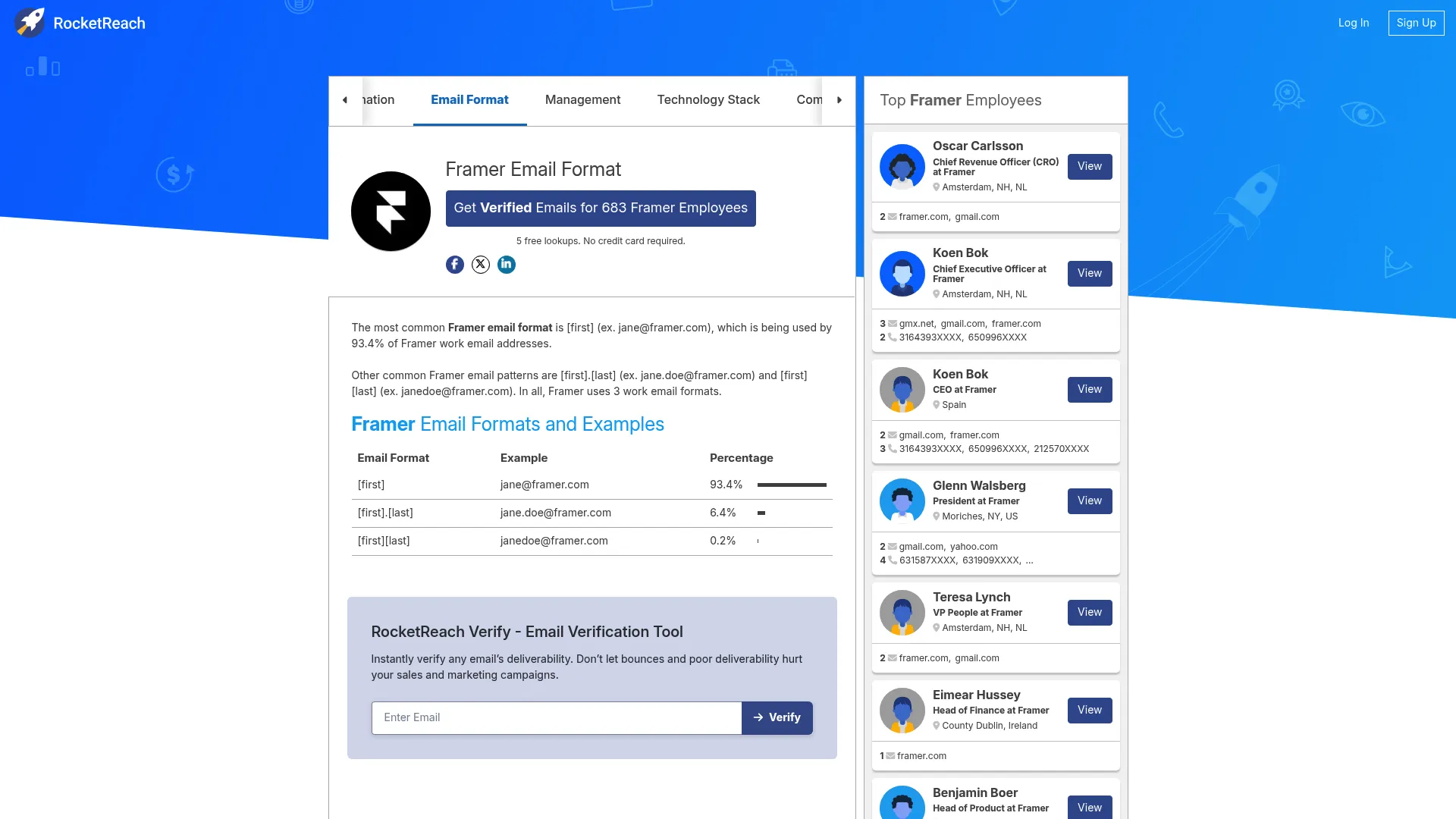
Not every message should go to a person. Role inboxes like support@, press@, or partnerships@ can be more reliable and faster, especially when your request isn’t tied to a specific employee. If you want a quick reference point for known patterns, you’ll often see databases like Framer Email Format mentioned—just treat them as a lead, not a guarantee.
One more thing: “email format” does not mean “this will always work.” It means “this is the most probable structure,” and your job is to verify that probability before you hit send.
The Most Common Patterns Companies Like Framer Use

Most modern SaaS companies follow a small set of predictable conventions. The challenge is that two patterns can look equally plausible until you find a real example. If you’re trying to work out the framer.website email format, it helps to know the shortlist of patterns that show up again and again in product-led teams, design tooling companies, and developer-focused orgs.
Name-based formats and their pros/cons
The most common “human” pattern is first.last@domain because it’s readable and scales well as headcount grows. The downside is it can get messy with duplicate names (two Alex Lees) and long surnames. When you’re guessing a Framer contact email, this is usually the first variant worth testing because it’s so widely used.
Short forms: initials and truncated names
Short formats like first@domain, f.last@domain, or firstl@domain are common when companies want shorter addresses or started early with a small team. The downside is collisions happen quickly, which forces extra rules (numbers, middle initials, or adding a dot). If you’re learning how to find framer.website email addresses reliably, you’ll want to include at least one short-form variant in your “top 3–5” guesses.
Regional edge cases: diacritics and multi-part surnames
Names with accents (like é, ñ, ü) are typically converted to plain ASCII (e → e, ñ → n), but companies differ on the exact transformation. Multi-part surnames can be joined with a dash, collapsed together, or only use the final portion. When you’re doing email format verification, these edge cases are where verification saves you from embarrassing mistakes.
Also, if you’re collecting leads through Framer forms and routing them to the right people internally, it helps to set up clean delivery rules—this guide on How to send Framer forms to is a useful reference for form-to-inbox workflows.
How to Identify the Framer.website Email Pattern in Minutes
When you need the framer.website email format quickly, you don’t need a complicated tool stack—you need a few dependable “evidence sources” and a way to cross-check them. I like to think of it like debugging: you gather signals, compare them, and only then commit to an assumption.
Check public sources: press, jobs, and docs
Start with pages that are meant to be shared publicly: press pages, job postings, and help docs. Sometimes you’ll find direct addresses, or at least role inboxes that reveal the domain and conventions (like whether they use hyphens, dots, or plain text). Even one verified address can reveal the likely framer.website email format pattern for named accounts.
Use email headers from newsletters or announcements
If you’ve subscribed to a company newsletter, confirmation emails and announcement emails sometimes expose sending addresses in headers (or at least reply-to addresses). You’re not trying to scrape anything—you’re just using information that already hit your inbox. This can be a fast way to confirm whether Framer email address format conventions match your guess.
Cross-check patterns using multiple data points
One data point can mislead you, especially if it’s a vendor sending on behalf of the company or a role inbox that doesn’t match employee mailboxes. Instead, look for two or three independent confirmations: a press contact here, a doc author there, a newsletter reply-to elsewhere. When these converge, your framer.website email format confidence jumps—and you can proceed to careful verification rather than blind sending.
If you’re doing this kind of “find the pattern” work often, it’s worth creating a short internal SOP so nobody on the team improvises. That’s the same playbook we use when maintaining component libraries: consistency beats cleverness, especially when multiple people touch the process.
A Step-by-Step Workflow to Generate Likely Emails (Without Spamming)
Once you’ve got a good sense of the framer.website email format, the next step is generating a small set of high-probability candidates. The key word is small. You don’t want to spray five emails at once and hope one lands—that’s a deliverability and reputation problem waiting to happen.
Start with the full name and role
Get the person’s name correct first—spelling, capitalization, and any preferred short name they use publicly. Then note their role (support, partnerships, marketing, engineering) because it affects whether a person-address or a role inbox is more appropriate. If you’re serious about how to find framer.website email targets, role context helps you pick the right destination, not just a valid mailbox.
Create 3–5 highest-probability variants
Create a short list of the most likely permutations based on your best evidence: usually first.last, first, f.last, firstl, and sometimes first_last. Don’t overdo it—three strong candidates beat fifteen weak ones. This keeps your email format verification step focused and reduces the temptation to “test everything” in a risky way.
Document assumptions so teams stay consistent
Write down the pattern you believe is correct, where you got it, and when you last confirmed it. This prevents a teammate from mixing patterns (or mixing domains) and creating noise in your CRM. In my experience, this tiny documentation step is the difference between “repeatable outbound” and “random acts of email.”
- Example note: “Assuming first.last@framer.website based on two public references dated Feb 2026. Verified 1 address via checker.”
- Example guardrail: “Do not send more than 1 email per person until verification passes.”
If your team also builds marketing pages in Framer, consider applying the same rigor to your UI system. A library like Components can keep page layouts consistent while your outreach process stays consistent too—same philosophy, different surface area.
How to Verify an Email Address Before Outreach (So You Don’t Burn Your Domain)
Verification is where people either protect their sender reputation—or accidentally wreck it. If you’re working with the framer.website email format, you want just enough verification to be confident, without doing anything that looks like abusive mailbox probing. This is especially important if you’re emailing from a primary business domain you care about.
Syntax and domain checks you can do instantly
Start with basics: does it contain illegal characters, double dots, or missing @ signs? Then confirm the domain is exactly right (no extra “www”, no misspelled TLD). A surprising number of failures come from typos like framer.webiste or adding a subdomain that doesn’t exist. This alone improves your framer.website email format success rate before you touch any tools.
Mailbox verification: what it can and can’t confirm
Email verification tools typically check domain MX records and may attempt an SMTP handshake to see if a mailbox appears deliverable. But many modern mail servers use catch-all settings, temporary responses, or anti-enumeration measures that make “valid/invalid” look fuzzy. Treat verification as a risk-reduction step for your Framer email address format guesses, not a perfect truth machine.
When to stop testing to avoid risky behavior
If you’re testing multiple variants for the same person, stop once you have a strong candidate—don’t keep hammering the domain for “certainty.” Excessive probing can trigger security defenses, and it’s simply not a good look. A practical rule: generate up to 3–5 candidates, verify lightly, then send one well-targeted email with a clear reason to respond.
If this is outreach tied to your product site, consider sending from a dedicated outreach domain or subdomain if volume grows—separating marketing/outreach deliverability from your primary domain is a common precaution. Not required for everyone, but it’s worth thinking about once you scale.
Role Inboxes at framer.website: When info@ Beats Guessing a Person

Sometimes the smartest move isn’t finding a person at all—it’s choosing the right role inbox. If you’re unsure about the exact framer.website email format for an employee, a role-based mailbox can be the fastest path to a real human response. You trade personalization for reliability, which can be the right deal depending on your goal.
Common role inboxes: support, press, partnerships
Most SaaS companies maintain standard inboxes like support@, press@, partnerships@, and security@ (sometimes). These addresses are typically monitored, ticketed, and routed internally. If you’re stuck on how to find framer.website email for a specific person, role inboxes can bypass that whole problem.
Choosing the right inbox for your purpose
Match your request to the team that can actually act on it. Product bugs and account issues go to support; media questions go to press; integration ideas go to partnerships. Using the wrong inbox wastes everyone’s time and can make your message look like mass outreach, even if it’s not.
How to write subject lines that get routed correctly
Routing is often automated, so your subject line should be specific and keyworded. A subject like “Partnership idea: Frameblox UI kit + Framer templates” tells a triage system where to send it and tells a human why it matters. If you do use a role inbox instead of a framer.website employee email, clarity in the first 8–10 words is what keeps your email from getting deprioritized.
As a quick aside: if your outreach relates to design systems or shipping faster in Framer, it helps to reference concrete assets. Pointing someone to a curated library like All components makes your message more tangible than a vague “we have a kit.”
Cold Email That Actually Sounds Human (Templates You Can Adapt)
Once you’ve got the framer.website email format nailed down (or you’ve chosen a role inbox), the next problem is tone. Most cold emails fail because they sound automated, overly broad, or weirdly intense. The sweet spot is calm, specific, and easy to respond to—especially if you’re emailing a busy SaaS team.
A short partnership pitch template
If you’re pitching a collaboration, keep it short and anchored in a specific outcome. Mention what you noticed, what you propose, and a low-friction next step (like a 10-minute call or a quick reply). Here’s a template you can adapt once you’ve confirmed the framer.website email format you’re using:
- Subject: Partnership idea: Frameblox UI kit + Framer audience
- Body: “Hey [Name] — I’m [Your Name], working on Frameblox (Framer UI kit + design system). We’ve built 400+ components and 900+ sections to help teams ship faster. Would you be open to a small co-marketing test (1 template + 1 email feature) if it’s a fit? If yes, I can send a one-page outline.”
A customer-support escalation template
When you’re escalating an account or billing issue, clarity beats persuasion. Include identifiers (workspace, invoice ID, timestamps) and one sentence explaining what you want changed. If you’re unsure of the right Framer contact email, send this to a support inbox rather than guessing an employee.
- Subject: Help needed: [Issue] for [Workspace/Account]
- Body: “Hi Framer team — we’re seeing [specific issue] on [date/time/timezone]. Account: [email/workspace]. What we’ve tried: [1–2 bullets]. Could you confirm whether this is expected and advise the next step?”
A press/media request template
Press requests go better when you offer context and constraints: what’s the story, what’s the deadline, and what you need (quote, asset, confirmation). Keep it respectful and easy to forward internally. After you confirm a framer.website email format or choose a press inbox, use something like:
- Subject: Media request: quick quote on [topic] (deadline [date])
- Body: “Hi — I’m [Name] from [Outlet/Company]. I’m writing a piece about [topic] and would love a short comment from someone at Framer. Deadline is [date/time]. Two questions: (1) [Q1] (2) [Q2]. If there’s a better contact, I’m happy to resend.”
If your email relates to a Framer launch, linking to a relevant landing page helps, but keep it tight. For example, if you’re referencing a promotion or seasonal offer, you might point to something like Framer Black Friday—only when it genuinely supports your ask.
Common Mistakes When Using the Framer.website Email Format
Even with a solid process, a few common mistakes can tank your results. If you’re serious about getting value out of the framer.website email format, it’s worth doing a quick “pre-mortem” on what usually goes wrong—especially when multiple teammates are emailing from the same domain.
Mixing framer.website with other Framer domains
This is the big one: using the wrong domain. A company can run multiple domains for marketing, product, or legacy reasons, and it’s easy to assume they’re interchangeable when they’re not. If you’re targeting the framer.website email format, be consistent—don’t accidentally send to a different domain and assume the pattern failed.
Forgetting plus-addressing and aliases exist
Some employees use plus-addressing (like name+tag@domain) for filtering, and some teams rely heavily on aliases that forward to internal systems. That means two different-looking addresses can route to the same place, and some “invalid” results in verification tools may simply reflect anti-enumeration defenses. This is why email format verification should be cautious and combined with real-world signals.
Assuming a pattern applies to every department
Even if you confirm one valid mailbox, it doesn’t prove every department follows the same rule. Support and press may use role inboxes, contractors may use a different domain, and acquisitions can bring their own conventions. The safest approach is: treat the framer.website email format as a strong default, and stay open to exceptions when evidence suggests them.
| Mistake | What it causes | Better approach |
|---|---|---|
| Wrong domain | Hard bounces, wasted follow-ups | Confirm domain from 2+ sources |
| Too many guesses | Deliverability risk | Limit to 3–5 candidates, verify lightly |
| One-size-fits-all pattern | Misrouted emails | Use role inboxes when appropriate |
Quick Troubleshooting When Emails Bounce or Go Silent
So you sent the email…and nothing happened. Or worse, you got a bounce notification. The good news is you can usually diagnose what happened quickly, and adjust without spiraling into “send more emails.” When dealing with the framer.website email format, a small set of smart checks beats a big set of repeated attempts.
Hard bounce vs. soft bounce: what to do next
A hard bounce usually means the address doesn’t exist or the domain is wrong—pause immediately and reassess your pattern. A soft bounce might be a temporary issue like a full mailbox or a transient server response—waiting and retrying later (once) is reasonable. If you see multiple hard bounces while testing a framer.website email format, stop and revisit your evidence sources.
Follow-up timing and channel alternatives
If you don’t get a bounce but you get silence, timing and relevance matter more than sending three more nudges. I’ve found a good default is one follow-up 2–4 business days later, then one final “closing the loop” message a week after that. If it’s still quiet, switch channels rather than hammering the same Framer contact email guess.
When to switch to forms, LinkedIn, or support portals
Some requests are better handled through official channels: support portals for account issues, contact forms for general inquiries, or LinkedIn for networking. If your goal is simply “reach the right human,” a form can route more reliably than guessing a framer.website employee email. And if you’re contacting someone about design systems or components, sending a concise LinkedIn message with a single link often gets a faster skim.
If your ask is about Framer builds and you want to show credibility, it helps to share something concrete—like a component demo or a systemized page section. A link to Code components (when relevant) can make your message feel grounded rather than abstract.
Your Next-Send Checklist: Get the Right Address, Verify, and Hit Send
If you want a simple way to operationalize all of this, use a checklist. It keeps your outreach calm and repeatable, and it reduces the odds you’ll accidentally burn deliverability while trying to confirm the framer.website email format. This is the same “checklist mindset” that makes launches smoother: fewer assumptions, fewer surprises.
Pick the best pattern and confirm it
Start by choosing one pattern that matches the strongest evidence you found (public contact info, headers, documentation references). If you can, confirm it with a second signal before you generate any addresses. The point is to treat the framer.website email format like a working hypothesis you validate, not a guess you defend.
Verify responsibly and document the result
Run basic syntax checks, confirm the domain, and use light-touch verification if you have access to it. Don’t brute force dozens of combinations; it’s not worth the risk. Then document what you used and what happened (delivered, bounced, replied) so the next person on your team doesn’t repeat the same experiment.
Send with a clear ask and a clean signature
Your email should make it obvious what you want and how to respond in under 15 seconds. Use a short subject line, 2–4 short paragraphs, and one clear CTA like “Is this worth a quick chat?” or “Who’s the right person for this?” A clean signature (name, role, company, one link) looks professional and improves trust when contacting a Framer contact email.
- Address: Uses the verified framer.website email format (or correct role inbox)
- Proof: One sentence that shows relevance (specific product/page/announcement)
- Ask: One clear next step (reply with yes/no, intro, or link)
- Safety: No mass CCs, no multi-variant blasting
If your outreach ties back to your own site experience, don’t underestimate the value of tight design execution. A consistent design system, good typography, and reusable sections make your landing pages feel trustworthy—exactly the kind of polish you get from a structured library like Styles. That polish doesn’t replace a correct framer.website email format, but it does make the reply more likely once your message lands.
Quick practical FAQ (for busy people):
- What’s the fastest way to find the framer.website email format? Find one confirmed address tied to the domain, infer the pattern, then verify a single candidate for your contact.
- Should I email a person or a role inbox? If your request is general (support, press, partnerships), role inboxes are often faster and safer than guessing a specific employee.
- How many variants should I test? Keep it to 3–5 high-probability options, then stop once you have a strong candidate—over-testing can create deliverability risk.
This article was created using Blogie.